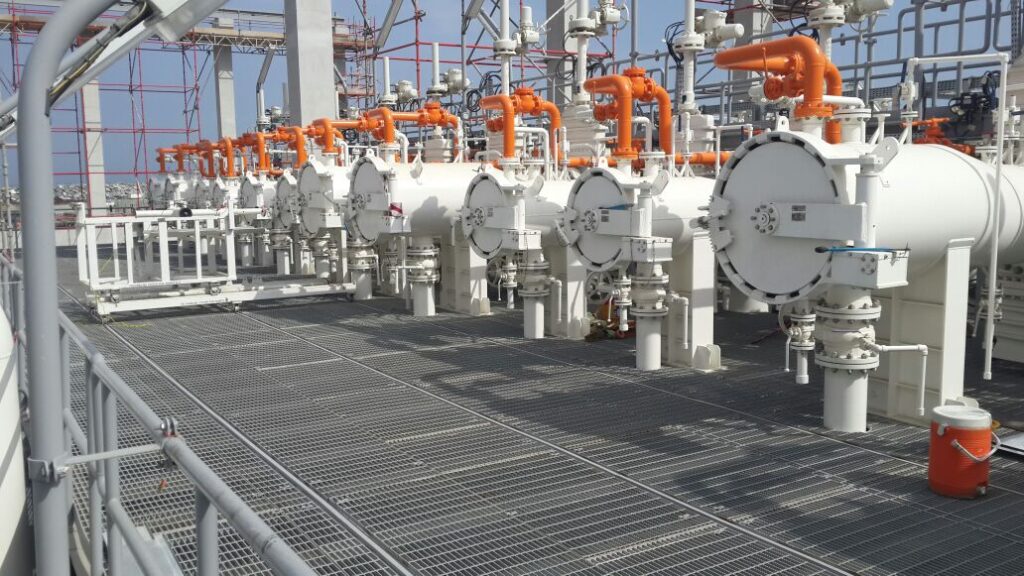
Purpose-Built Equipment for Hydrogen Pipelines
VKVC designs and manufactures hydrogen-service pig launchers, receivers, pipeline repair clamps, and flow tees — engineered to resist hydrogen embrittlement and fabricated in full compliance with ASME B31.12 and ASME Section VIII.
Contact
For enquiries: sales@vkvc.com
Certification Badges (below hero)
• ASME B31.12 Compliant
• ASME U, U2, UM Stamp Holder
• HIC / SSC Tested Materials
• Hardness ≤22 HRC Guaranteed
• NACE MR0175 Compliant
Every product we manufacture for hydrogen service is built with hydrogen embrittlement-resistant materials, controlled-hardness welding, and rigorous quality controls that go far beyond conventional oil and gas requirements.
Designed and fabricated to ASME Section VIII Div. 1 with full ASME B31.12 material compliance. Our hydrogen-service pig launchers and receivers feature HIC-tested plates, GTAW root passes, mandatory PWHT, controlled heat input welding, and hardness-verified welds across base metal, HAZ, and weld deposit — ensuring zero risk of hydrogen-induced cracking during pigging operations
Engineered for emergency and permanent repair of hydrogen transmission pipelines. Our hydrogen-service repair clamps use embrittlement-resistant forged and plate materials with controlled chemistry (C ≤0.18%, S ≤0.005%),
hydrogen-compatible elastomeric or metallic seals, and full hardness mapping of all welded joints. Available in bolt-on and welded-on configurations for live or shut-down repairs.
Flow tees designed and manufactured specifically for hydrogen pipeline service. All metallic components are fabricated from hydrogen embrittlement-resistant grades with controlled hardness and chemistry. Full-penetration welds with GTAW root passes, mandatory PWHT, and 100% volumetric NDE ensure safe and reliable performance in high-purity and blended hydrogen transmission systems. Available in scrapper tee and barred tee configurations.
Our quick opening closures for hydrogen launcher/receivers feature pressure-rated hub forgings in hydrogen-compatible grades, full-penetration welds with GTAW root and controlled SAW fill, mandatory PWHT, and precision-machined sealing surfaces. Every QOC undergoes 100% UT, MT, and production hardness testing before dispatch. In-house seal moulding available up to 72” NB.
Weld overlay and clad pressure vessels and launchers for hydrogen environments where internal corrosion resistance is required alongside hydrogen embrittlement protection. Our overlay processes use low-dilution
techniques with Alloy 625 or 316L stainless steel, with full chemistry and hardness verification of the overlay deposit per ASME and NACE requirements.
Beyond standard products, VKVC offers custom hydrogen-service fabrication for pipeline spools, manifolds, headers, traps, drip pots, and ancillary pipeline equipment. All custom fabrication follows the same hydrogen-specific manufacturing protocol: HIC-tested materials, controlled welding, PWHT, delayed NDE, and comprehensive hardness surveys.
Hydrogen service is unforgiving. We have built our manufacturing processes, quality systems, and metallurgical expertise specifically to address the unique demands of hydrogen embrittlement-resistant fabrication.
22 | Maximum HRC Hardness — Guaranteed | Every base metal, heat-affected zone, and weld deposit is hardness-tested and verified to ≤22 HRC, eliminating hydrogen embrittlement risk at the source. |
100% | Volumetric NDE on All Welds | No spot examination. Every butt weld receives 100% radiographic or ultrasonic testing, plus MT/PT on all welds including attachments — with 48-hour delayed NDE as standard. |
H4 | Ultra-Low Hydrogen Consumables | All welding electrodes and wires meet H4/H5 diffusible hydrogen classification (≤4–5 ml/100g), with strict baking and holding oven protocols enforced on every shift. |
0.005 | Sulfur Content ≤0.005% — Clean Steel | Calcium-treated, killed and fine-grain steel with ultra-low sulfur and phosphorus, sourced from approved mills with full HIC test certification per NACE TM0284. |
GTAW | TIG Root Passes — Standard Practice | GTAW (TIG) root passes on all pressure-retaining welds as standard for hydrogen service, providing the highest quality root fusion with minimal hydrogen pickup. |
PWHT | Mandatory Post-Weld Heat Treatment | PWHT on every hydrogen-service vessel regardless of thickness — eliminating residual stresses that dramatically accelerate hydrogen embrittlement in service. |
VKVC manufactures hydrogen equipment in compliance with the following international codes and standards:
• ASME B31.12 — Hydrogen Piping and Pipelines
• ASME Section VIII Div. 1 & Div. 2 — Pressure Vessels
• NACE MR0175 / ISO 15156
• NACE TM0284 — HIC Testing
• NACE TM0177 — SSC Testing
• API RP 941 — Nelson Curves
• EIGA Doc 121/14
• CGA G-5.6
• ASME B16.5 / B16.47
• API 6D
VKVC supplies hydrogen-service pipeline equipment to operators and EPC contractors across major hydrogen infrastructure markets.
Middle East & GCC UAE, Qatar, Saudi Arabia, Oman | India National Green Hydrogen Mission | Europe European Hydrogen Backbone | Asia-Pacific Australia, Southeast Asia, Japan |
Hydrogen is rapidly emerging as a critical energy carrier in the global transition to clean energy. As hydrogen pipeline networks expand across the Middle East, India, Europe, and Asia-Pacific, pipeline operators face a unique engineering challenge: hydrogen is the smallest molecule in existence, and it behaves fundamentally differently from natural gas, crude oil, or refined petroleum products inside steel pipelines and associated equipment.
When hydrogen comes into contact with carbon steel at pipeline pressures, hydrogen atoms diffuse into the steel’s crystal lattice and accumulate at grain boundaries, inclusions, and areas of high residual stress. This process — known as hydrogen embrittlement (HE) — causes a dramatic reduction in the steel’s ductility and fracture toughness, potentially leading to catastrophic brittle failure without warning. Closely related degradation mechanisms include hydrogen-induced cracking (HIC), where internal cracks form around flattened manganese sulfide inclusions, and stress-oriented hydrogen-induced cracking (SOHIC), where HIC cracks link up through the wall thickness under applied or residual stress.
These mechanisms make it essential that every component in a hydrogen pipeline system — including pig launchers and receivers, pipeline repair clamps, flow tees, quick opening closures, and ancillary pressure equipment — is manufactured using hydrogen embrittlement-resistant materials and fabrication processes specifically designed to minimise hydrogen damage risk.
VKVC, established in 1969, is a specialist manufacturer of pressure vessels, pig launchers and receivers, pipeline repair clamps, flow tees, quick opening closures, and pipeline equipment. Our hydrogen-service manufacturing programme addresses every critical factor that differentiates hydrogen equipment from conventional oil and gas equipment: material chemistry restrictions, hardness control throughout all weld zones, mandatory post-weld heat treatment, ultra-low hydrogen welding consumables, delayed non-destructive examination, and full compliance with ASME B31.12 — the dedicated ASME code for hydrogen piping and pipelines.
Our metallurgical expertise, in-house welding engineering capability, over 20 welding bays, advanced CNC machining capacity, and established relationships with approved material suppliers allow us to deliver hydrogen-service equipment that meets the most stringent operator and EPC contractor specifications.
The global hydrogen pipeline market is experiencing unprecedented growth, driven by national hydrogen strategies, green hydrogen production mandates, and the development of cross-border hydrogen transmission corridors such as the European Hydrogen Backbone. India’s National Green Hydrogen Mission, the GCC’s hydrogen export ambitions, and Asia-Pacific’s growing hydrogen demand are
creating significant new requirements for hydrogen-service pipeline equipment manufactured to internationally recognized codes and standards.
VKVC is positioned to serve this growing market with hydrogen-ready manufacturing capabilities, proven metallurgical expertise, and a commitment to the safety-critical quality standards that hydrogen service demands. Whether you are building a new hydrogen transmission pipeline, converting existing natural gas infrastructure for hydrogen blending, or maintaining an operating hydrogen line, VKVC provides the specialist equipment you need — engineered and built for hydrogen from the ground up.
For enquiries: sales@vkvc.com
WhatsApp us